
Your website runs other people’s code. Last week, that went wrong for 178 organisations.
What the Optimizely attack means for UK businesses with a website, a booking form or an online shop
By Dave Kelsey, Head of Operations, Clearsky IT · Published 23 November 2026
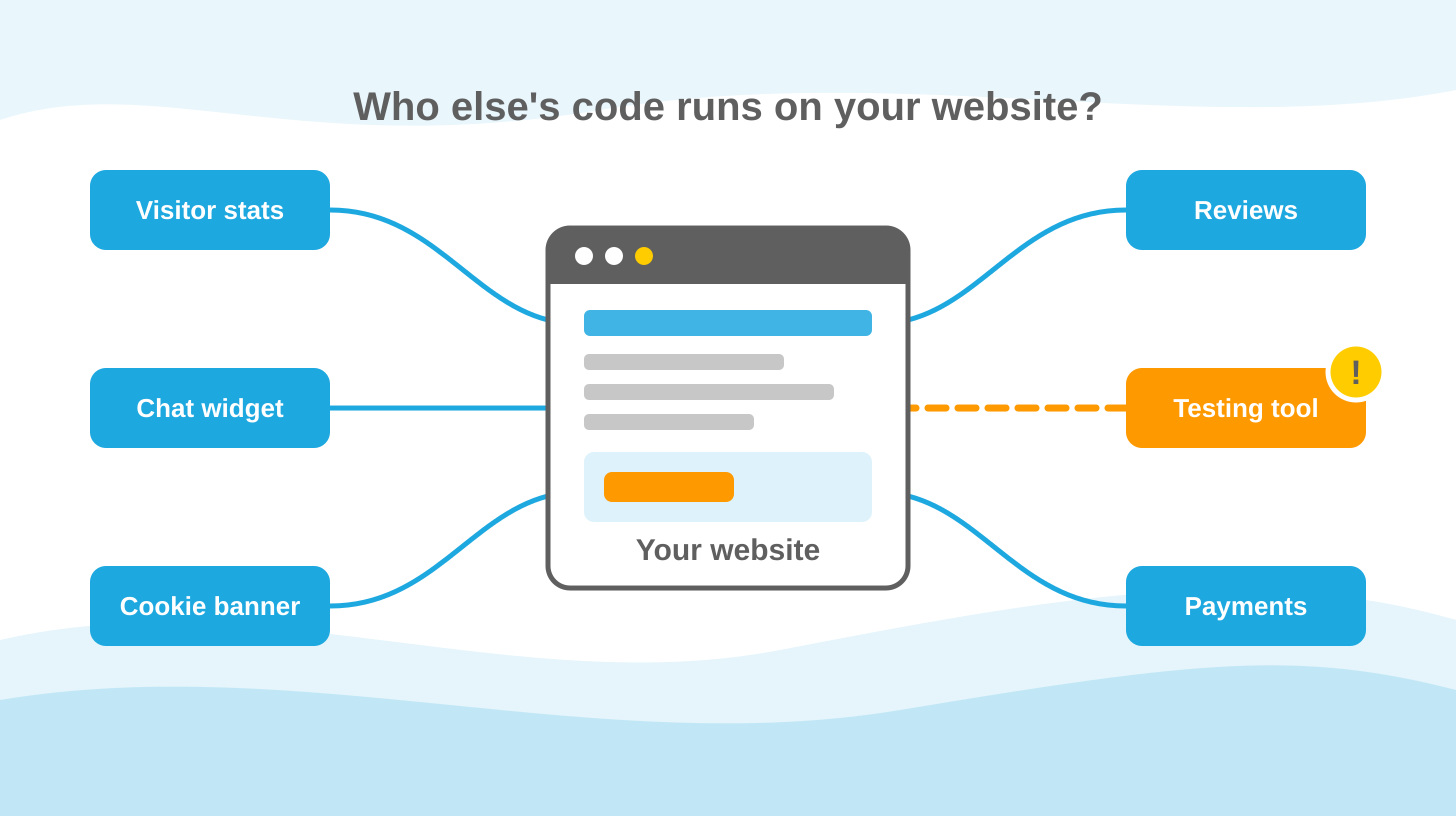
If your business has a website, it almost certainly loads small pieces of code from other companies every time someone visits. Visitor statistics, the chat bubble in the corner, the cookie banner, a review widget, an embedded booking calendar and the payment form are usually all supplied this way. These third-party website scripts run in your visitors’ browsers with the same level of trust as the rest of your site.
On Monday, 16 November, one of those suppliers was used to attack the visitors of 178 organisations at once. With Black Friday on 27 November and Christmas trading underway, this is a good week to see how your own website is loading.
What happened
Optimizely sells tools that let businesses test different versions of their web pages. Customers add a short script to their site, and Optimizely delivers the content. Optimizely says an attacker exploited a weakness in its account sign-up process to inject malicious code into some customer projects. Because that code arrived through Optimizely’s normal delivery route, browsers had no reason to treat it as suspicious.
Security researcher Scott Helme of Report URI spotted the problem the same day. His team checked 1,611 Optimizely scripts and found malicious code in 188 of them, belonging to 178 organisations. Names reported include the BBC, Zoom, Salesforce, HSBC and IKEA. The injected code could capture payment card details typed into forms, swap cryptocurrency wallet addresses and collect cookies. Optimizely says it fixed the weakness and removed the code within hours, and that fewer than 5% of its customers were affected.
The affected organisations did not have their own systems broken into. Their visitors were exposed because a supplier they trusted was.
This has happened before
In 2018, thousands of websites, including the Information Commissioner’s Office’s own, quietly ran cryptocurrency-mining code after Browsealoud, a widely used accessibility plug-in, was tampered with. The same year, attackers altered a script on British Airways’ website and collected personal data, including payment card details, from around 430,000 customers and staff. The ICO later fined BA £20 million.
Why third-party website scripts matter to a smaller business
The big brands made the headlines, but the method works just as well against small sites. Many SME websites were built by an agency some years ago and have since accumulated plug-ins and tracking codes. Often, nobody inside the business knows what is on there, or who still has a login.
Your customers will not be able to distinguish between your code and your supplier’s. If card details or personal data are taken through your website, it is your name in the address bar, and under UK GDPR, it is your responsibility as the organisation collecting that data. Online shops and booking sites are the obvious targets at this time of year because that is where card numbers are typed in. A simple enquiry form is still worth protecting because names, email addresses, and phone numbers are exactly what fraudsters use to make their next scam more convincing.
This is the same supplier risk that underlies the government’s new cyber law, as covered in our article on changes to UK cyber law. Your website is part of your supply chain too.
What we don’t know yet
Optimizely has published only a short account so far, and outside investigators are still working on it. Report URI’s figures come from its own scanning, so the real number of affected sites could be higher. Helme also points out that a page loading the bad code is different from a customer losing money, and nobody yet knows how many card details were actually taken. Treat early figures with some caution.
Practical steps for this week
- Ask for a list. Ask whoever manages your website for every third-party script and plug-in it loads, what each one does and who supplies it. A competent developer can produce this quickly.
- Remove what you no longer use. A tracking code from an old marketing campaign or a chat tool you cancelled last year is still a supplier you trust.
- Check who can change your site. Every login to your website, hosting and tag manager should use multi-factor authentication. Remove accounts for former staff and agencies.
- Keep card details off your own pages. If you accept payments, ask your payment provider whether customers enter their card details on the provider’s hosted page or on your own page. A hosted page keeps card entry away from the other scripts on your site.
- Ask about a Content Security Policy. This is a website setting that tells browsers which sources are allowed to run code and where data can be sent. It will not stop every attack via a trusted supplier, but it makes it much harder for code to reach unknown servers.
- If you use Optimizely, check now. Follow Optimizely’s incident notice and review your projects for code added on 16 November.
- Include your website in supplier reviews. When you assess supplier risk, include the companies whose code runs on your site, not just the ones you pay for IT and software.
Speak to us
Website scripts tend to fall between the web developer, the marketing team and IT support, which is why they so often get missed. Clearsky IT is a managed service provider based in Wiltshire, providing IT support, cyber security and Cyber Essentials assessments. If you would like a second pair of eyes on what your website is loading, or help putting the right questions to your web developer, email us at hello@clearskyit.co.uk or visit clearskyit.co.uk.
Sources
- Report URI (Scott Helme), “World’s Largest Brands Infected With Malware Via Optimizely”, 16 November 2026: blog.report-uri.com
- Optimizely, Web Experimentation security incident notice, 17 November 2026 (Optimizely status page)
- BleepingComputer, “Optimizely supply chain attack delivers malware to CNN, Fox News, BBC, Salesforce sites”, November 2026: bleepingcomputer.com
- CMSWire, “Optimizely works through Web Experimentation security incident”, November 2026: cmswire.com
- ICO, penalty notice: British Airways, October 2020: ico.org.uk
- NCSC, Supply chain security guidance: ncsc.gov.uk
